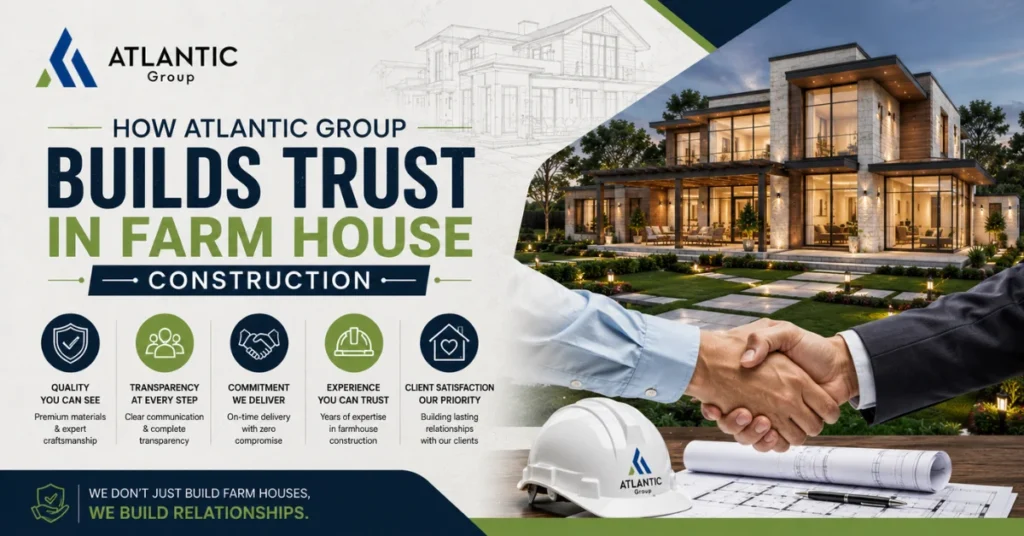
Trust in construction isn’t something a company can claim its way into — it’s built through what actually happens on site, phase after phase, and whether the people responsible for a project are still answering for it months after the concrete has cured. For a farm house project specifically, where budgets are significant and timelines stretch across many months, this kind of trust matters more than a polished portfolio ever could.
This article looks at the specific practices behind how Atlantic Group earns that trust on farm house projects, through our Farm Houses service, rather than simply asserting it.
Trust Starts With a Documented Process, Not Promises
A verbal assurance that “everything will be handled” isn’t a process — it’s a hope. What actually builds confidence on a construction site is a documented sequence: written scope of work, milestone-based inspections, and sign-offs at each phase before the next one begins. When a foundation is poured, it’s checked against the structural drawings before the grey structure phase starts. When electrical and plumbing rough-in is complete, it’s tested before walls are closed up. This isn’t extra paperwork for its own sake — it’s what prevents a small oversight from becoming a hidden problem discovered only after handover.
One Company, One Point of Accountability
A common source of disputes in farm house construction is a fragmented chain of responsibility — a separate architect, a separate structural engineer, and a separate contractor, each able to point to the other when something goes wrong. Atlantic Group’s Architectural & Design Services and Construction Services function as one contracted relationship with the client, not two. That means there’s no ambiguity about who is responsible if a finished structure doesn’t match the approved design — it’s the same team on both ends.
An In-House Team, Not a Revolving Door of Subcontractors
Institutional knowledge matters more than it’s usually given credit for. A company that relies heavily on day-to-day subcontracted labor, hired fresh for each project, loses continuity between what was learned on one farm house and what’s applied to the next. Atlantic Group’s core architects, engineers, and site supervisors work across projects as an ongoing team, which means lessons from one site — a soil condition, a material supplier issue, a design detail that needed adjusting — carry forward rather than being relearned from scratch each time.
Transparent Communication During Construction
Trust erodes fastest when a client feels out of the loop. Regular site visits, clear documentation of any design changes, and a single point of contact who can answer questions without needing to “check and get back to you” are what keep a farm house project feeling manageable rather than opaque. When a change is requested mid-construction — and on a project this size, some usually are — it should be documented in writing before it’s acted on, so both sides have a clear record of what was agreed and why.
Honest, Upfront Budgeting
Vague estimates that grow significantly once construction starts are one of the fastest ways a construction company loses a client’s trust. A detailed cost breakdown by category — structure, finishing, landscaping, and any recreational features — set before construction begins gives property owners a realistic basis for decisions, rather than a number designed mainly to win the initial conversation. Our earlier breakdown of farmhouse construction cost factors in Lahore covers this in more detail, including where costs typically shift during a project and why.
Structural Engineering You Can Verify
Every structural decision on a farm house project should be backed by calculations a client can ask to see, not just a verbal assurance that “it will be fine.” Architects registered with the Pakistan Council of Architects and Town Planners are held to a professional standard that supports this kind of accountability, since there’s a recognized body a client can turn to if something is seriously mishandled. Atlantic Group’s design team operates under this same standard as a baseline, not an exception.
Support That Doesn’t End at Handover
A farm house project doesn’t stop being the company’s responsibility the moment the keys are handed over. Warranty coverage, as-built documentation, and a clear path for maintenance questions after move-in are part of what separates a company willing to stand behind its work from one that considers the relationship finished at final payment. Atlantic Group’s Consultancy Services remain available to clients well past handover, for exactly this reason.
A Track Record You Can Actually Check
Trust should never have to be taken on faith alone. Property owners are welcome to review completed farm house work directly on our projects page, and to ask for references from past clients rather than relying on photographs alone. For a closer look at the technical side of what separates a stronger farm house company from a weaker one, our earlier article on what makes a top farm house design company covers this from an engineering and project-history perspective.
Conclusion
Trust on a farm house project isn’t won through a single conversation or a well-designed brochure — it’s earned through a documented process, a single accountable team, honest budgeting, and a willingness to stay involved after the project is technically finished. These are the standards Atlantic Group holds itself to on every farm house project, not because clients ask for them, but because they’re what makes a project actually go well from the first site visit through the years that follow.
📞 Call Us Today: 03054500053
FAQs
What makes a construction company trustworthy for a farm house project?
A documented, milestone-based process, single-team accountability across design and construction, transparent budgeting, and support that continues past handover are the clearest practical signs of a trustworthy company.
Does Atlantic Group provide a detailed cost breakdown before construction begins?
Yes, we provide a category-based cost estimate covering structure, finishing, and landscaping before construction starts, rather than a single rough figure.
How does Atlantic Group handle mid-construction design changes?
Requested changes are documented in writing and confirmed with the client before being acted on, so there’s a clear record of what was agreed and why.
Is Atlantic Group’s design team professionally registered?
Yes, our architectural team operates under the professional standards set by the Pakistan Council of Architects and Town Planners.
What kind of support does Atlantic Group offer after a farm house is completed?
We provide as-built documentation, warranty coverage, and ongoing consultancy support for maintenance and future planning questions.
Can I speak with past clients before deciding to work with Atlantic Group?
Yes, we’re able to share references from previous farm house clients, and completed projects can be reviewed directly on our projects page.