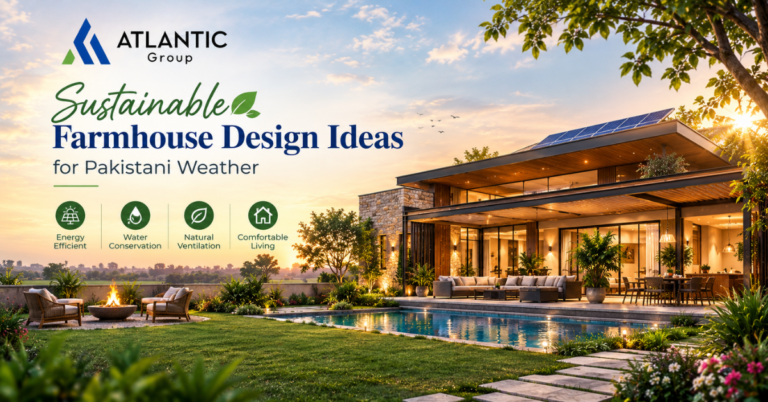
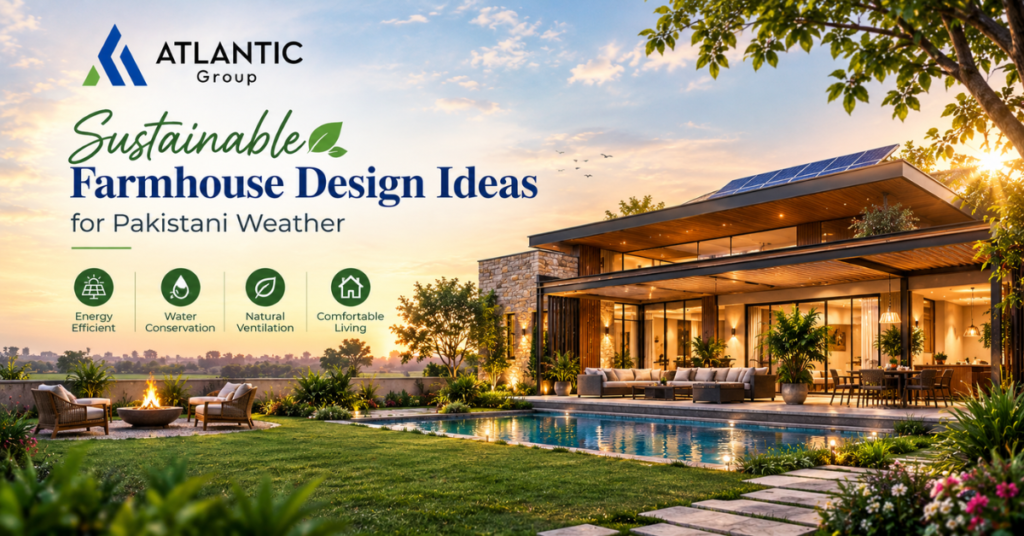
Pakistan’s climate doesn’t leave much room for generic design choices — summer temperatures that regularly cross 40 degrees in Punjab, a monsoon season that tests drainage and waterproofing, and electricity costs that make inefficient cooling systems genuinely expensive to run year after year. Sustainable farmhouse design here isn’t really about following a trend; it’s about building a house that performs well against conditions that aren’t forgiving of poor planning.
This guide covers the sustainable design choices that actually hold up in Pakistan’s climate, based on what we build into farmhouse projects through our Farm Houses service from the earliest design stage.
Pakistan’s solar potential is genuinely strong by global standards, and the Alternative Energy Development Board has been tracking this growth as solar adoption accelerates nationally. For a farmhouse specifically, that potential translates into real, practical savings rather than just a marketing feature.
Passive Cooling Through Building Orientation
Orienting a farmhouse to minimize direct afternoon sun exposure on major living spaces, particularly west-facing walls, reduces indoor heat buildup before any mechanical cooling system even switches on. This is one of the lowest-cost sustainability decisions available, since it costs nothing beyond planning the layout correctly from the start, yet it has a measurable effect on how hard air conditioning systems have to work through summer months.
Natural Ventilation and Airflow Design
Cross-ventilation — windows and openings positioned to let air move through a space rather than sit stagnant — reduces dependence on mechanical cooling during Pakistan’s milder months and supplements it during peak summer. Double-height spaces and strategically placed high windows also help hot air escape upward rather than accumulating at living level, which is particularly useful in farmhouse layouts that already favor open, airy interiors.
Solar Energy Integration
Given Pakistan’s consistently high solar irradiance, rooftop solar panels have shifted from an optional add-on to one of the more financially sensible investments a farmhouse owner can make, particularly on larger roof areas typical of farmhouse construction. Planning for solar from the design stage, through our Architectural & Design Services, allows roof structure, panel orientation, and wiring to be integrated cleanly rather than retrofitted around a finished roof later.
Water Conservation and Rainwater Harvesting
Monsoon rainfall, while disruptive if poorly managed, represents a genuine opportunity on a large farmhouse plot — rainwater harvesting systems can capture runoff for irrigation use, reducing dependence on groundwater for landscaping needs. Our earlier guide on landscaping ideas for large farmhouse plots in Punjab covers how irrigation planning connects directly to this kind of water conservation strategy.
Insulation and Material Choices for Extreme Heat
Material selection has a direct effect on indoor comfort in Pakistan’s climate — proper roof insulation alone can meaningfully reduce indoor temperatures during peak summer, while thermal mass materials like stone and brick help moderate temperature swings between day and night. These choices matter more on a farmhouse than a typical city home, simply because the larger roof and wall surface area means poor material choices compound across more square footage.
Shading Strategies: Overhangs, Verandas, and Landscaping
Deep roof overhangs and covered verandas do double duty in sustainable farmhouse design, providing outdoor living space while shading walls and windows from direct summer sun. Strategic tree placement adds to this effect over time, and our Construction Services team coordinates this kind of shading planning with the main structural build so overhang depth and window placement are designed together rather than decided separately.
Energy-Efficient Lighting and Systems
LED lighting throughout, combined with daylighting strategies that reduce how much artificial light is needed during the day, adds up to meaningful savings on a property with as much square footage as a typical farmhouse. Smart controls that adjust lighting and climate systems based on actual occupancy, rather than running on fixed schedules regardless of use, extend these savings further without requiring residents to manage everything manually.
Balancing Sustainability With Budget
Sustainable features add upfront cost, and understanding where that cost goes — solar systems, higher-spec insulation, rainwater infrastructure — helps property owners prioritize realistically rather than trying to include everything at once. Our earlier breakdown of farmhouse construction cost factors in Lahore covers how these sustainable systems factor into overall budget planning, and our Consultancy Services can help sequence which features to prioritize first based on actual return.
Conclusion
Sustainable farmhouse design in Pakistan isn’t a single feature, it’s a set of decisions — orientation, ventilation, solar, water use, and material choice — that work together to make a farmhouse genuinely comfortable and affordable to run in a climate that doesn’t tolerate shortcuts. Getting these decisions right from the design stage costs far less than retrofitting them later, and the long-term savings in utility costs alone often justify the investment. If you’re planning a farmhouse and want sustainability built in from day one, we’re glad to walk through what makes sense for your plot and budget.
📞 Call Us Today: 03054500053
FAQs
Is sustainable farmhouse design significantly more expensive to build?
It adds some upfront cost, mainly for solar and insulation, but many sustainable choices like proper orientation and shading cost little to nothing extra when planned from the start.
How much can solar panels actually save on a farmhouse’s electricity costs?
Savings vary by system size and usage, but given Pakistan’s strong solar potential, well-sized systems often offset a significant portion of a farmhouse’s electricity costs over time.
What’s the most cost-effective sustainable feature to start with?
Proper building orientation and shading typically offer the best value, since they reduce cooling loads at little to no added construction cost.
Does rainwater harvesting make sense for every farmhouse plot?
It’s most valuable on larger plots with significant landscaping to irrigate, where it meaningfully reduces dependence on groundwater or municipal water sources.
Can sustainable features be added to an existing farmhouse later?
Some, like solar panels and LED lighting, can be retrofitted relatively easily, while others, like orientation and insulation, are far more effective when planned into the original design.
Does Atlantic Group help plan sustainable features alongside the main farmhouse design?
Yes, our team incorporates sustainability into the same design and construction process as the rest of the farmhouse, rather than treating it as a separate add-on.